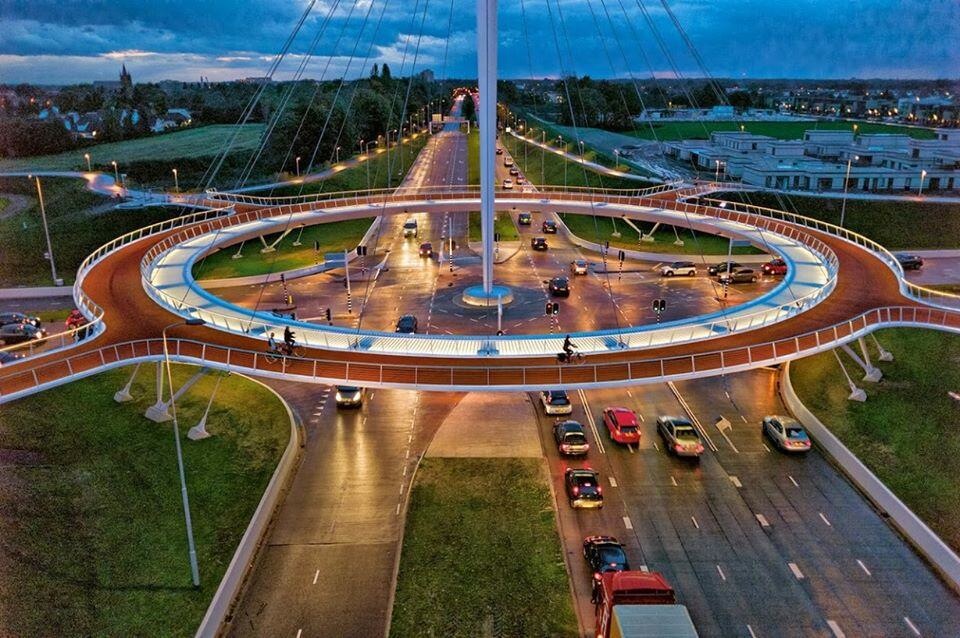
I want a Hovenring in Charlottesville.
Would you prefer to raise the gas tax or pay for each mile you drive? America’s infrastructure is crumbling. Literally (archived: 2014). How might we pay for it?
Proposals for taxing vehicles’ miles traveled have been around for a long time.
A quick search on Richmond Sunlight shows that this bill “Motor fuel tax; joint subcommittee to study replacement with mileage-based fee. (HJ626)” failed to make it out of committee in 2009.
Virginia’s Department of Transportation released a study in December 2008 (archived: 2022) that addressed many of the options available for a VMT tax:
One alternative widely proposed to the fuel tax is a “Vehicle Miles Traveled” (VMT) tax. Under this system, drivers pay a fee based on miles traveled rather than a tax on the amount of fuel used. The VMT tax concept can serve broader policy aims as well, by enabling policy makers to set variable fees in different network areas to reduce congestion during peak travel times, a critical and worsening issue in some metropolitan areas.
Some specific possible implications for real estate:
– Real estate agents might be less inclined to do full-day tours for incoming buyers
– I’d be tempted to encourage more drive-bys of homes and drive-throughs of areas than I do already
– We might see further hyper-local focus on areas and neighborhoods. When I was a new real estate agent in 2001, I used to go all over. As my career developed and gas prices went up, my geographical range for representation has shrunk. I tend to not go to Trevillians or Faber or Pratts very often anymore.
– Increase in bicycle use? Right now in most European countries, bikes are outselling cars. This, I’d say, is a good thing.
– Human settlement patterns may see even more trending towards denser urbanization.
– Higher demand for public transportation.
Bacon’s Rebellion noted in 2007 Oregon’s successful implementation of Vehicle Miles Traveled tax (no longer available):
â–ª A mileage fee can be implemented to replace the gas tax as the principal revenue source for road funding.
â–ª The mileage fee can be paid at the pump, making it almost indistinguishable from the motorist’s perspective, from how they pay the tax now.
One note: the efficiency of a silent tax makes collection easier, much as I remember payroll taxes being almost forgotten (back when I used to get a regular paycheck). But. I believe taxpayers should see and feel taxes. Silence encourages politicians to ever-so-easily nudge the taxes up with little taxpayer pushback.
To keep things dead simple and eliminate privacy concerns, technological challenges (government’s recent history with implementing technology as an example) – do as some commenters at Slashdot suggest and check the odometer at annual inspection and pay the tax then.
But. The NAR raises some questions (archived: 2015) that would have to be answered (one supposes) prior to any implementation: (bolding mine)
With the loss of revenues from the federal gas tax, states like California and Oregon tested a Vehicle Miles Tax pilot project, which proposed a tax based on how many miles you drive, not how much gas you buy. This idea was met with a host of concerns: What if you drive out of state? Which state gets that money? One possible method of collecting the tax is an electronic odometer and a Global Positioning System (GPS) to record miles. When the car pulls into a gas station, its mileage is uploaded to a wireless reader, which sends the information to the gas station’s computer. It’s then compared to the car’s last reported mileage. Taxable miles are computed, and the tax is assessed. However, there are privacy concerns about this tracking, McGinn indicated.
Ultimately, we need to pay to sustain and improve our infrastructure – in Charlottesville, Albemarle, Central Virginia and beyond. How we pay for it (and whether we trust government) are other questions.

Interested in Learning More?
I have been been representing buyers and sellers in Charlottesville, Albemarle, and Central Virginia since 2001. Get local insight born of experience.
Dig Deeper
Always Read Covenants and Restrictions
You never know what you're going to find when you dig into Covenants and Restrictions. "1. No shop, store, trailer, temporary living structure, factory, hospital, asylum, institution, tourist home or business house of any kind, and no apartment house shall be erected or maintained on…

Revisiting the “0 to 5 Buyer is Gone” Post – 15 years later
Revisiting the “0-5 Buyer Is Gone” Theory We’re in a different market now. Some of the people who bought between 2021 and 2024 are trying to sell — and the ones who bought new construction, now competing against new construction, are having a hard time.…
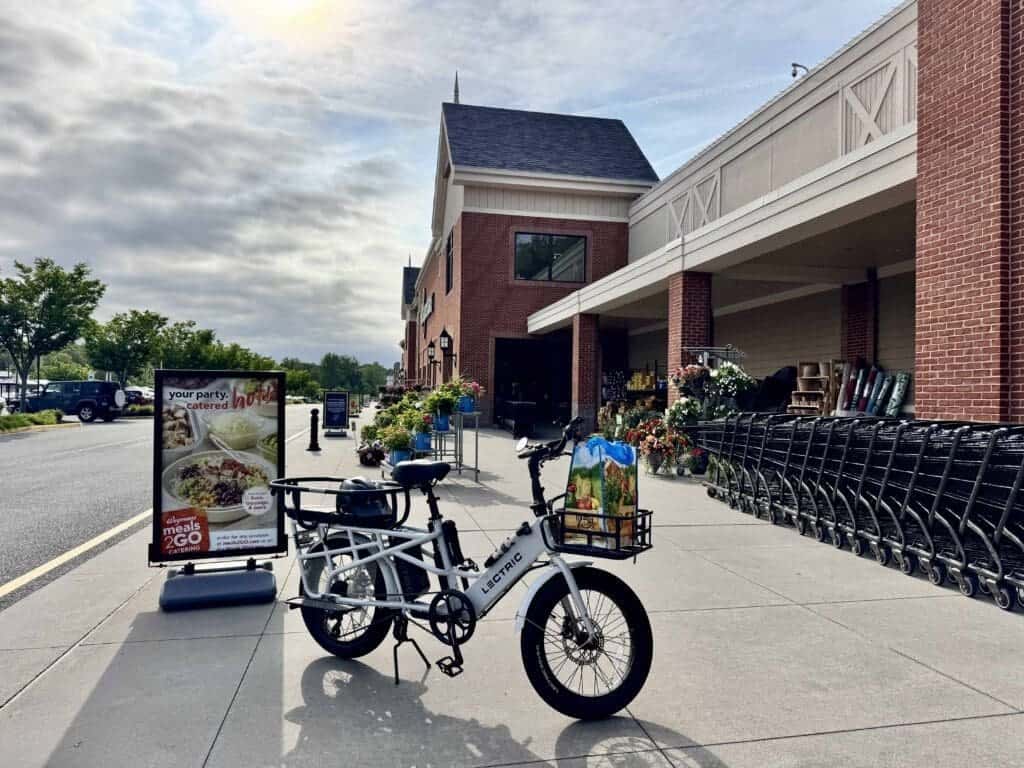
A Charlottesville e-bike Success Story
I have an e-bike. I love my e-bike. I ride it to meetings all over the City of Charlottesville instead of driving my car. e-bikes are great. A friend got an e-bike. He loves his e-bike. He has a different perspective, and I asked him…

Flipping the Switch, Part 3: ADUs, Zoning, and the Practical Guide
Flipping the Switch, Part 3: ADUs, Zoning, and the Practical Guide Part 1 covered the data. Part 2 covered the design. This week: the regulatory landscape, the ADU reality check, and the practical checklist. The ADU Conversation Has Changed When I wrote about this in…