

What a Multi-Generational Home Actually Looks Like in 2026 (Part 2 of 3)
Last week I wrote about the data behind multi-generational living. This week: what does that actually look like inside a house?
In 2015, I described the ideal “parent suite” as fewer steps, wider doorways, a zero-entry shower, and privacy for all. I wasn’t quite “wrong,” but I hadn’t studied the data. I knew what I experience on a daily basis.
NAHB now lists Universal Design as a top architectural trend. Zero-step entries, wide doorways, lever handles, walk-in showers — these aren’t “aging-in-place” features anymore. They’re mainstream. And Universal Design was never about wheelchairs. It’s about spaces that work for a toddler and a 78-year-old and everyone in between. A curbless shower is easier for a kid and safer for grandma. It’s just better design.
The biggest shift in multi-generational home design is the rise of dual primary suites — we have a few of these in the Charlottesville market, and I’ve seen them used more by older couples than multi-generational families, so far.
Not a master bedroom and a guest room. Two real primary suites — each with a full bathroom, decent closet, and some separation from the rest of the house. We’re starting to see more nearly self-contained spaces with a private entrance or separate hallway, a sitting area, maybe a kitchenette. We need more of this. A huge challenge is how families afford such spaces.
Main-level living has become the other big filter. If your parent is going to live with you, they need a bedroom, bathroom, and living space, often on the first floor. Stairs can be a dealbreaker. This is where our market gets tricky — a lot of the housing stock is two-story with bedrooms only upstairs – and we’ve been that way for a long time. The homes that have a true first-floor suite are in high demand and short supply.
I see this mismatch constantly. A buyer comes to me and says, “We want a home where my mom can live on the first floor.” Great. But.
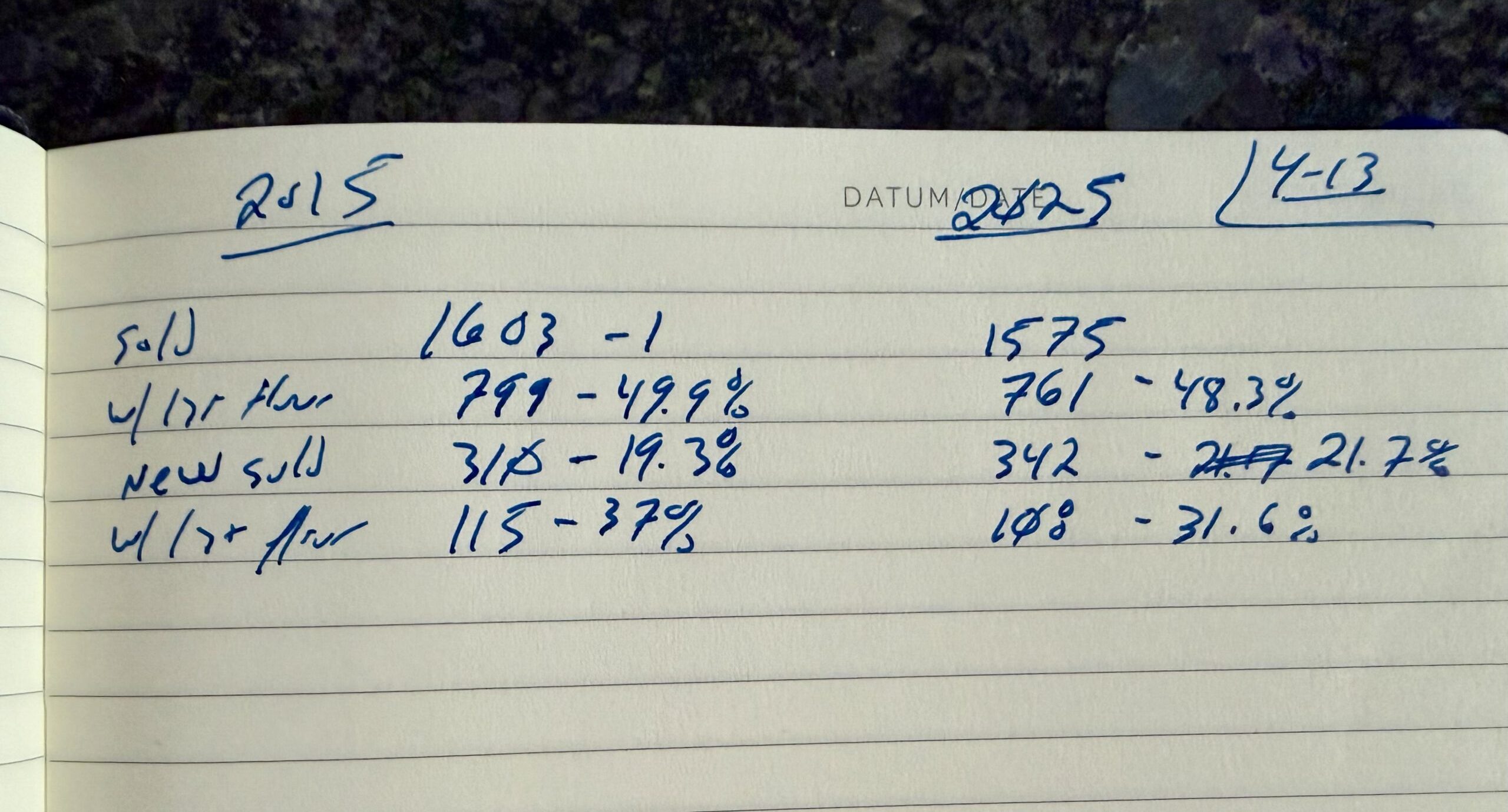
In 2025, about 48% of resale homes sold in our market had some form of first-floor living — almost identical to 2015 (49.9%). That number hasn’t moved in a decade. So when a buyer says “we need first-floor living for mom,” they’ve just eliminated roughly half the inventory. New construction is worse: only 31.6% of new homes sold had a first-floor primary, down from 37% in 2015. And the median price of those new-construction homes with first-floor primary living in Albemarle? $1,020,292. Builders are building what multi-generational families need — but not at a price most of them can afford.
A bit deeper
51.9% of these were cash. 56 of 108.
- Under $500K: 4 homes (3.7%)
- $500K–$749K: 14 (13.0%)
- $750K–$999K: 35 (32.4%)
- $1M+: 55 homes (50.9%)
Half these homes sold for over a million. Half were cash.
So what should you actually be looking for if you’re house-hunting with multi-generational living in mind?
The minimum: A bedroom and full bath on the main level. Ideally not the one next to the kitchen that was clearly designed as an office. A real bedroom with a door that closes and a window.
The better version: A first-floor suite with some separation — maybe at the opposite end of the house from the other bedrooms. Its own bathroom. Or an ADU. Enough space that it doesn’t feel like a hotel room.
The ideal: A true in-law suite or pod — separate entrance (or close to it), bedroom, full bath, kitchenette or at least a wet bar, and a living area. This is what I’m seeing more clients ask for, and what almost nobody can find in existing inventory without renovation.
Here’s the practical stuff that matters and doesn’t show up in the listing description – although my clients are digging deep and zooming in close on photos – Doorways need to be at least 32 inches clear — 36 is better. Most older homes have 28- to 30-inch doorways. That’s fine until it’s not. Bathrooms need grab bars, or at least blocking in the walls so you can install them later without tearing out tile. Step-free entry matters — one step at the front door might as well be a wall for someone with a walker. Plan ahead (ask me if you have questions)
The kitchen question depends entirely on the family. Some want a full second kitchen; some just want a coffeemaker and a mini fridge so mom can have her morning routine without navigating the family chaos. It depends.
The best time to think about this is before you need it. The best time to integrate Universal Design is during construction — wide doorways, blocking for grab bars, a curbless shower can be no-brainers. Retrofitting later means tearing out finished walls and re-tiling bathrooms. (I did this during the height of Covid – it sucked).
The families who do this well plan two moves ahead. They’re buying in their 40s or 50s and thinking about what the house needs to look like when they’re 65 and when their parents are 85. And here’s the part that doesn’t get enough attention: a home with a well-designed first-floor suite appeals to a wider range of buyers at resale. You’re not just solving today’s problem. You’re building options.
Next week: ADUs, accessory dwelling units, and the changing regulatory landscape in Virginia. Plus: the practical guide — what to consider if you’re buying, building, or renovating for multi-generational living in the Charlottesville area.

Interested in Learning More?
I have been been representing buyers and sellers in Charlottesville, Albemarle, and Central Virginia since 2001. Get local insight born of experience.
Dig Deeper

Always Read Covenants and Restrictions
You never know what you're going to find when you dig into Covenants and Restrictions. "1. No shop, store, trailer, temporary living structure, factory, hospital, asylum, institution, tourist home or business house of any kind, and no apartment house shall be erected or maintained on…

Revisiting the “0 to 5 Buyer is Gone” Post – 15 years later
Revisiting the “0-5 Buyer Is Gone” Theory We’re in a different market now. Some of the people who bought between 2021 and 2024 are trying to sell — and the ones who bought new construction, now competing against new construction, are having a hard time.…
A Charlottesville e-bike Success Story
I have an e-bike. I love my e-bike. I ride it to meetings all over the City of Charlottesville instead of driving my car. e-bikes are great. A friend got an e-bike. He loves his e-bike. He has a different perspective, and I asked him…

Flipping the Switch, Part 3: ADUs, Zoning, and the Practical Guide
Flipping the Switch, Part 3: ADUs, Zoning, and the Practical Guide Part 1 covered the data. Part 2 covered the design. This week: the regulatory landscape, the ADU reality check, and the practical checklist. The ADU Conversation Has Changed When I wrote about this in…