THE STORY
Main Street, Closed to Cars
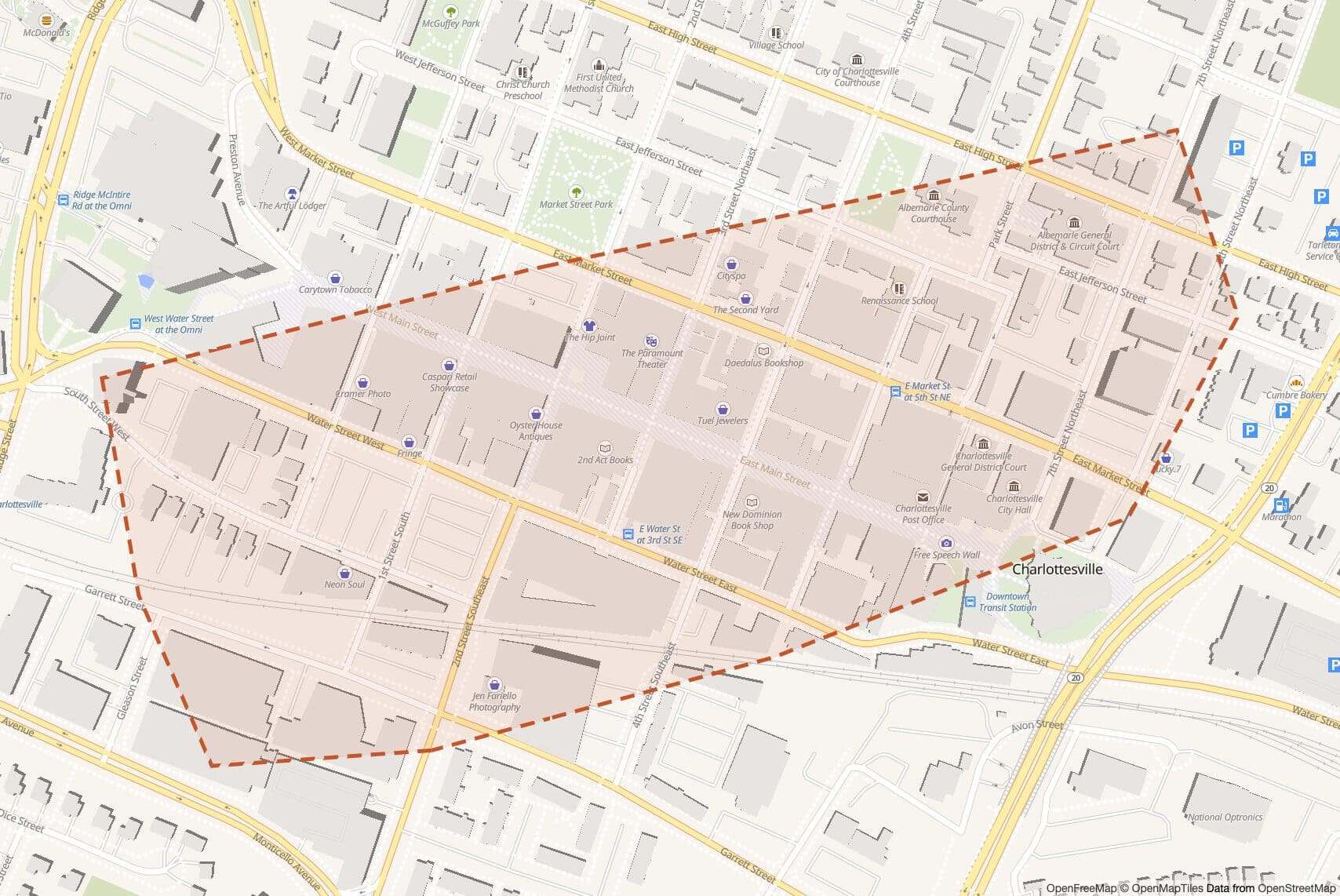
In 1976, Charlottesville did something that seemed radical at the time: it closed Main Street to traffic, laid brick from storefront to storefront, and planted willow oaks down the middle. The design came from Lawrence Halprin, the landscape architect behind San Francisco’s Ghirardelli Square, and the result — eight blocks of pedestrian mall — is now one of the longest and most successful of its kind in the country. Plenty of cities tried the same experiment in that era. Most ripped theirs out. Ours became the center of town.
For its first few decades, though, the Mall was a place you visited, not a place you lived. That changed in the mid-2000s, when buildings like the Holsinger and Norcross Station brought the first real wave of condo living downtown. The Pavilion opened at the east end in 2005, the Paramount reopened after a thirty-year dark stretch, and suddenly downtown had an actual residential population walking to dinner instead of driving to it.
The 2010s filled in the rest: the Waterhouse building on Water Street, the C&O Row townhomes, and 550 Water, a glass-and-brick building that won national attention when it was completed in 2018. Add the IX Art Park just across the tracks to the southeast, and the blocks around the Mall now hold more homes than at any point in the city’s modern history.
Downtown is a small market — a handful of buildings, a limited number of doors — and that scarcity shows up in the prices. Units range from smaller condos in the older buildings to seven-figure homes at 550 Water and the Holsinger. When something good comes on the market here, it rarely lingers.
TIMELINE
Downtown Through the Years
-
1976
Main Street closes to cars and reopens as the brick pedestrian Downtown Mall, designed by landscape architect Lawrence Halprin.
-
1980s–1990s
Retail drifts toward Route 29 and the Mall works to find its footing. Restaurants, the ice park, and a movie theater slowly rebuild the draw.
-
2004–2006
The Paramount Theater reopens after decades dark, the Pavilion opens at the Mall's east end, and buildings like the Holsinger bring the first significant wave of condo living downtown.
-
2013–2018
Waterhouse, C&O Row, and 550 Water add new homes on and around Water Street. The IX Art Park opens just southeast of the Mall in 2014.
-
Today
A compact residential district of condos, lofts, and townhouses wrapped around the Mall, its theaters, and the Saturday City Market.
CHARACTER
What It’s Like to Live Here
Architecture: Downtown living is vertical and relatively new by Charlottesville standards — mid-2000s condo buildings, converted commercial and warehouse space, brick townhomes at C&O Row, and the modern glass of 550 Water. Almost nothing here is a detached house; you’re buying a unit in a building, usually with an elevator and a condo association.
Getting Around: This is the best Walk Score in the city — 99 at the center of the Mall. Daily errands, dinner, a show at the Paramount or the Jefferson, the Saturday City Market: all on foot. The free trolley runs to UVA, the Downtown Transit Station anchors the Mall’s east end, and the Market Street and Water Street garages handle the car you’ll use less than you expect.
The Vibe: The Mall is the town’s living room, and living here means living in it — Fridays After Five crowds at the Ting Pavilion, buskers on the bricks, coffee at Mudhouse, and restaurants that fill up on weekends. It’s livelier and louder than any other neighborhood in town, which is precisely why people choose it.