THE STORY
The Neighborhood the Factory Built
Woolen Mills exists because of water. There has been a mill where Moores Creek meets the Rivanna since the 1790s, and by 1840 the Charlottesville Factory was turning out textiles on the site. Union troops burned it near the end of the Civil War, and in 1868 Henry Clay Marchant rebuilt the operation as the Charlottesville Woolen Mills. For nearly a century it made uniform cloth — for military academies, police departments, and railroad conductors — and the company built the village around it: worker housing along East Market Street, and in 1887 a chapel, built by the mill hands themselves on land the company donated.
The mill closed in 1962, and for decades the neighborhood was one of Charlottesville’s quietest corners — a dead-end road, a shuttered factory, and a collection of 19th-century houses that most of the city forgot about. That obscurity turned out to be a preservationist’s best friend. The village kept its scale and its architecture, and in 2010 the Woolen Mills Village Historic District was added to the National Register of Historic Places.
The factory’s second act arrived in 2020, when the restored mill complex reopened as The Wool Factory — home to Selvedge Brewing, the Broadcloth restaurant, and an events venue that has made the east end of Market Street a destination again for the first time in sixty years.
Today Woolen Mills is a mix of original mill houses, mid-century homes, and newer infill, threaded together by the river, the trail network, and a neighborhood association that pays close attention to what happens next. It is one of the few places in Charlottesville where you can stand in one spot and read the city’s whole industrial history.
TIMELINE
Woolen Mills Through the Years
-
1795
A grist mill is established where Moores Creek meets the Rivanna River — the site that gives the neighborhood its reason for being.
-
1840s
The Charlottesville Factory produces textiles on the site; the earliest company-built worker housing dates to 1847.
-
1868
After Union troops burned the mill at the end of the Civil War, Henry Clay Marchant rebuilds it as the Charlottesville Woolen Mills, known for uniform cloth.
-
1887
Mill employees build the Woolen Mills Chapel on land donated by the company. Its tapered bell tower still marks the neighborhood.
-
1962
The mill closes after nearly a century of operation. The village settles into decades of quiet at the edge of the city.
-
2010
The Woolen Mills Village Historic District joins the National Register of Historic Places, recognizing 104 contributing structures.
-
2020
The restored factory reopens as The Wool Factory — brewery, restaurant, and events venue — bringing daily life back to the mill site.
CHARACTER
What It’s Like to Live Here
Architecture: The historic district holds the original mill village — modest frame worker houses from the 1880s through the early 1900s, many with their original form intact. Outside the district you’ll find mid-century houses and newer infill, so the housing stock spans more than a century within a few blocks.
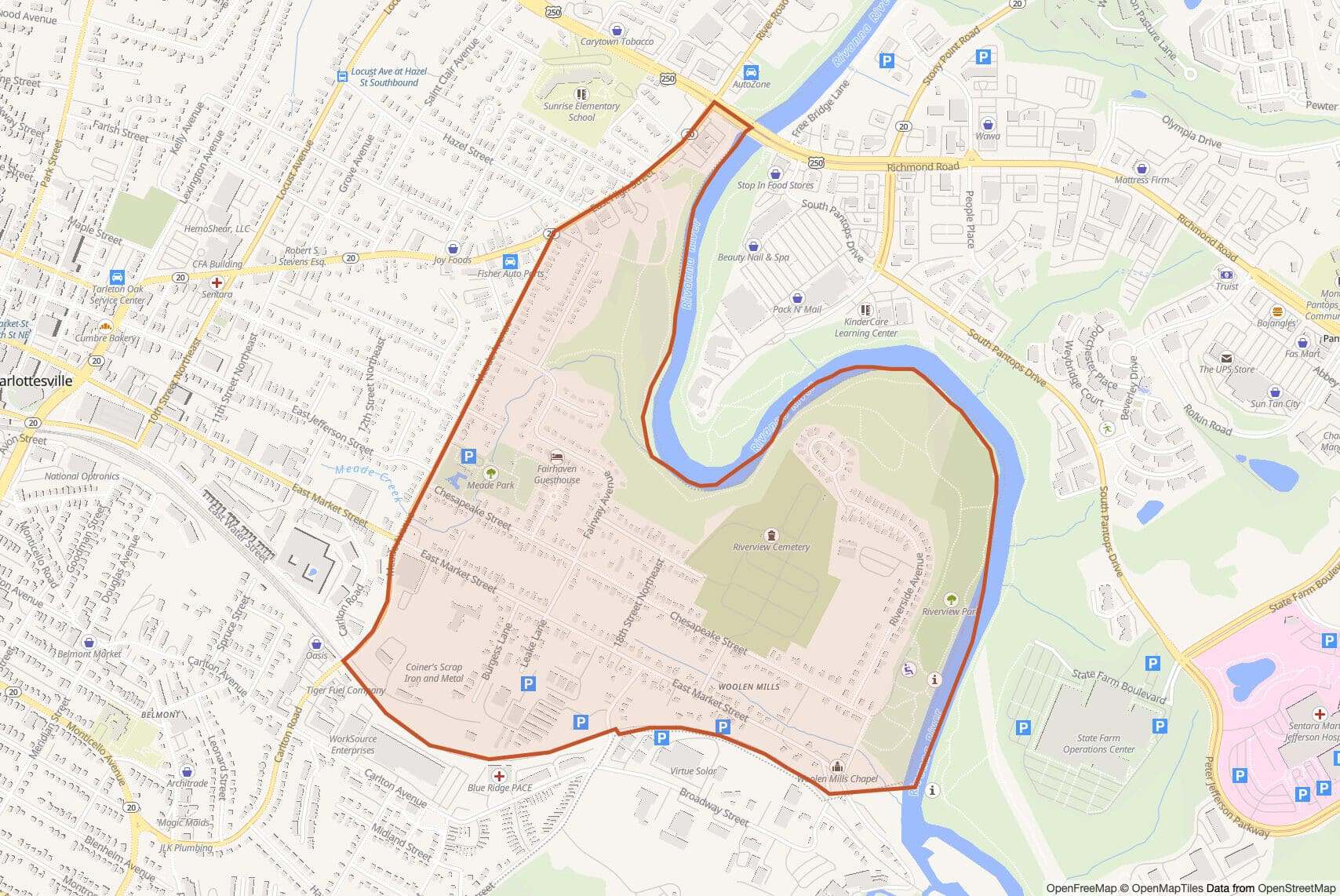
The River: This is Charlottesville’s most river-oriented neighborhood. Riverview Park sits at the north end with flat, popular trails along the Rivanna, and the Rivanna Trail threads the neighborhood’s edges. Kayaks and tubes go in near the old mill dam site in summer.
Getting Around: East Market Street and Meade Avenue are the two ways in and out, and that dead-end geography is part of the appeal — there is no cut-through traffic. Downtown is a short drive or an easy bike ride; walking to the Mall is doable but it’s a real walk, not a stroll.
The Vibe: Quiet, historic, and fiercely attentive. The neighborhood association has spent decades weighing in on zoning and preservation, and it shows — Woolen Mills has kept its character while the factory at its heart found a new use.