It’s rare that I read something that I share everywhere; this story is first in a long time. The Schools We Need: When public education fails, democracy fails with it (archived: 2014)
Read the whole thing (archived: 2014).
After reading all of these existential scenarios, I decided to hand out an essay by John Taylor Gatto called “Against School: How public education cripples our kids, and why.” A career New York City schoolteacher, Gatto argues that students are bored because they are supposed to be. The education system is intentionally designed to shape them into a passive mass who will, in bovine fashion, join the labor force and become unthinking mass producers and mass consumers. Public education, in Gatto’s estimation, is a scheme dreamed up by the captains of industry to incubate servility and ultimately sabotage anything like a real democracy. I don’t think my classes quite bought into Gatto’s conspiracy theory (“yeah . . . maybe . . . whatever”), but they did agree that the American high school classroom is pretty damn dull.
…
I suspect the hesitancy by many high school teachers to hold active class discussions about real moral and ethical dilemmas may be a byproduct of how contested and politicized the word values has become. No one wants to talk about them because someone might become offended, or someone might say the wrong thing, or the messiness of open debate might get exposed.
…
Deborah Meier, a senior scholar at NYU’s Steinhardt School of Education and a founder of the Coalition of Essential Schools, suggests that we replace the cover-the-material mode of teaching by cultivating a “habit of mind” that can be applied to all material. Such a habit nurtures the intellectual skills students need to make decisions on complex matters and is based on such things as: quality of evidence (how do we know it’s true?), consideration of various viewpoints (how would it look through someone else’s eyes?), the search for patterns and causes (what are the consequences?), and relevance (who cares?). These criteria will serve students well on any standardized test because they will have been taught how to evaluate the evidence before them, regardless of what it may be. And Meier’s last question, “who cares?” speaks directly to my students’ complaint about the relevancy of subject matter, because their demand for assignments that are relevant to real life does have merit. In the year 2011, real life can be quite scary, and helping students to navigate it requires a much more challenging curriculum.

Interested in Learning More?
I have been been representing buyers and sellers in Charlottesville, Albemarle, and Central Virginia since 2001. Get local insight born of experience.
Dig Deeper
Be Kind. It Matters
Reupping this story from April. This encounter has stuck with me. In early January I was returning a gift, and tried to get it put back on my wife’s credit card, which I didn’t have. The young girl working at the counter tried to make…

Deleting Facebook – An Experiment (Part 1 of 2)
"If you're not the customer, you're the product," as the saying goes. I am tired of being the product.* I have a new facebook account; the old one is deactivated. Why? I've long said I hate facebook, but use it because I must - for RealCrozetVA community,…
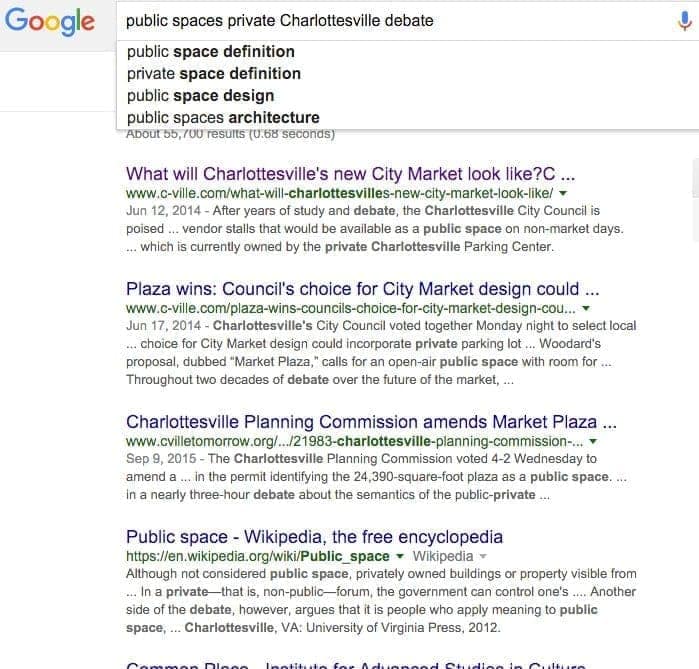
Public Spaces in Private Spaces – What’s the Balance?
What if ... the only available public spaces to freely assemble are private? The forthcoming Market Plaza in Downtown Charlottesville is going to be a massive project, Market Plaza will feature 68 residential units, 55,000 square feet of office space and 10,000 square feet of retail…
Looking For Christmas Trees and Lights in Charlottesville?
This is last year's post with Christmas tree farms and locations - I'll update it this year, if anything has changed.